
Chambersburg Previous Residents Sources
For Chambersburg previous residents, use a source that fits the period rather than expecting one continuous list. The land trail begins with the parcel and recorded parties. Historic tax books, identified directory editions, telephone volumes, and census schedules add dated household clues. Borough land-use material can date a project or review, but it does not establish a household. Each record answers a narrower question, and its date belongs in the research notes.
| Source | Years it covers | Where held | What it can show |
|---|---|---|---|
| Deed index books | 1784-2019 | Franklin County Archives | Recorded-party index route for a property trail. |
| Grantor indexes | 1784-1985 | Franklin County Archives | Parties disposing of property. |
| Grantee indexes | 1786-1898 | Franklin County Archives | Parties acquiring property. |
| Tax assessment books | 1848 onward | Archives and repository | Freeholders, taxpayers, and selected historic fields. |
| Valuation records | 1786-1807 | Franklin County Archives | Early property and tax context. |
| Identified directories | 1869 through 1949 spot editions | Catalog and genealogy access points | Name, address, occupation, or business clues. |
| Telephone directories | 1952-1961 identified runs | Cataloged library holdings | Listed household or business entries. |
| Federal census | 1790-1950 released | National Archives and authorized access | Household grouping and census-specific details. |
| Borough documents | Historical range not published | Land Use or Public Works | Dated project, curb, excavation, use, or hearing context. |
Use the current parcel trail first for a recent question. For an older Chambersburg address, move to the archive index books before assuming a missing web result means a missing record. The table does not prove continuous residence. It provides dates and custodians that can be tested against one another.
The county Taxes page explains the assessment and tax-claim functions behind a property card.
For an address history, the assessment record is a parcel checkpoint. It must be compared with recorded documents and dated household sources.
Franklin County's Earliest Trail
Franklin County formed from Cumberland County in 1784. That boundary matters when a Chambersburg property or family line seems to vanish before that year. The county archive directs pre-1784 researchers to Cumberland County records, rather than treating the absence as proof that the local trail ended. Land warrants can predate Franklin County, so the jurisdiction should be written beside every early citation.
The Franklin County Archives & Records Management describes nearly seven miles of records and an unusually broad series of land, tax, estate, and vital material. Its online repository adds selected images and catalog records over time, but the public catalog is not a complete inventory. Calling or emailing staff and arranging an appointment is the practical fallback when the right book is not visible online.
Note: For a pre-1784 land or family question, shift the jurisdiction search to Cumberland County and cite that transition.
Trace Chambersburg Previous Residents
A recorded title chain is the best starting point for former ownership, not a promise of former residence. Begin with the current parcel record, then use the Franklin County Register & Recorder and its LANDEX access route to find the conveyance to the present recorded owner. The legal description and UPI should travel with the notes. A similar street number or a matching surname is not enough to join two deeds.
When a current online search stops, the archive's deed-index books and grantor-grantee books take over. LANDEX offers a browser WebStore for limited searches and a separate Remote product for recurring use with a debit account and time/page billing. Its public landing page does not publish Franklin County's exact online start date, so do not invent an electronic cutoff. Use the counter or archive indexes for the earlier link.
- Find the current parcel and capture its UPI, legal description, and the distinction between the situs and mailing addresses.
- Locate the recorded deed to the current owner and record the grantor, grantee, recording date, and book, page, or instrument reference.
- Search the seller as a prior grantee, then test the earlier acquisition against the same legal description or parcel evidence.
- Repeat backward one conveyance at a time, keeping a citation for every link and marking uncertain matches.
- Move to the Archives or the Register & Recorder counter when the remote result cannot reach the needed period or image.
- Grantor
- The party transferring an interest in a recorded conveyance.
- Grantee
- The party receiving that interest. A prior grantee search can reveal a seller's earlier acquisition.
- Chain of title
- A documented sequence of recorded transfers for the same property. It is distinct from a chain of occupancy.
- Legal description
- The land description in a recorded document. It is safer than an old street number when comparing historic records.
Chambersburg Previous Residents, UPI
Franklin County's 20-character Uniform Parcel Identifier is a useful bridge between current assessment work and recorded land documents. The identifier includes dots and dashes, and the Tax Assessment Office verifies or assigns it for recordation when required. Copy it exactly. It helps distinguish one historic property from another with a reused number or a familiar owner name.
The county's Landex Record Alert uses the same parcel number. Launched on January 7, 2025, it can notify a subscriber when a document referencing a registered UPI is recorded or corrected. It is a watch tool, not proof that a document is accurate or that an address history is complete.
The alert screen belongs after the parcel is confirmed. It supports careful monitoring of a known property while the deed chain is documented from original county records.
The county's UPI program page explains why the certified parcel number should be copied before beginning the recorded-document search.
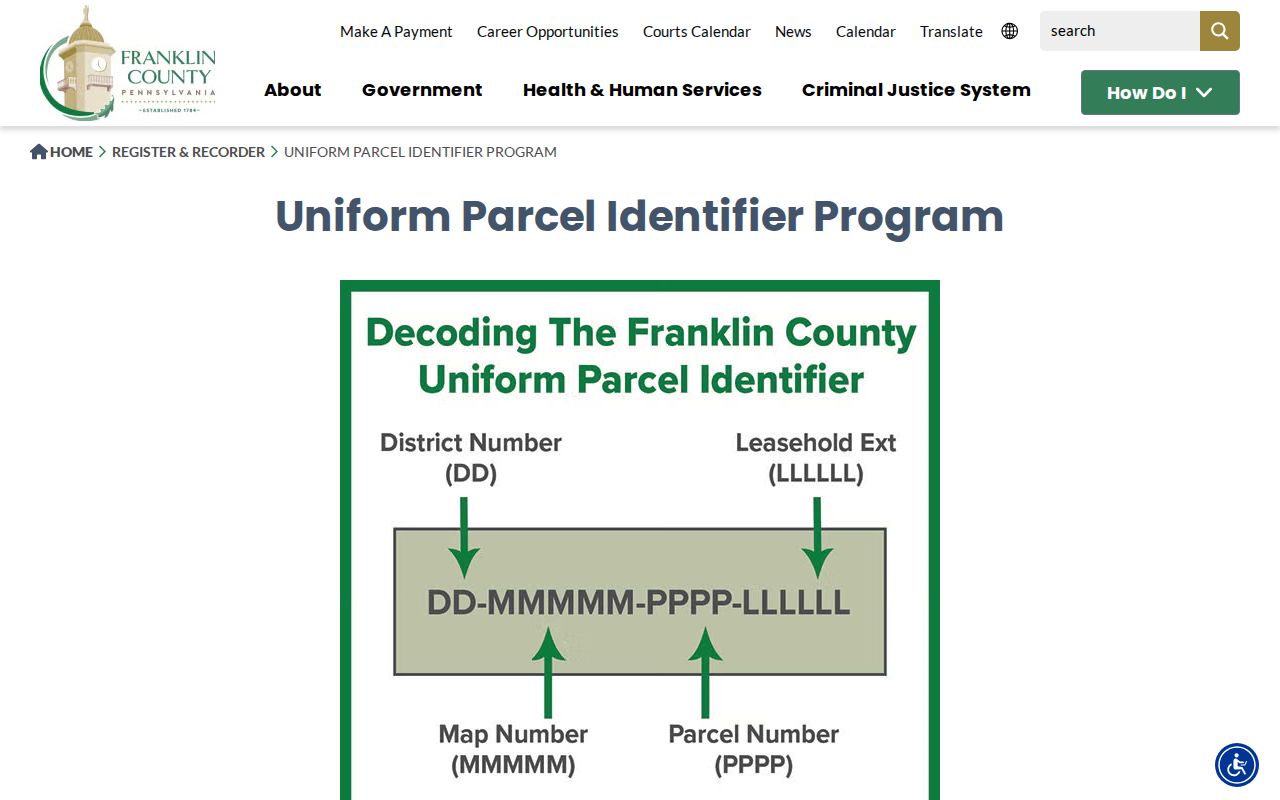
The UPI is the property key that can carry the research from a current record to older deeds and archive indexes.
Chambersburg Past Residents in Directories
Directories are spot-year evidence for past residents, not a complete roll. Identified Chambersburg material includes business directories for 1869 and 1871-1875, an 1876/77 edition, city directories for 1882, 1884, 1887, 1947, and 1949, plus the 1884-85 Sheriff & Taylor composite and the 1887 Boyd composite. Telephone-directory runs have been identified for 1952-1956 and 1957-1961. Those are known editions, not an annual sequence.
The FCHS-K Genealogy Library in Chambersburg's Old Jail is the local counter channel for asking about a cataloged city-directory, telephone, or address-arranged volume for a target year. No verified local reverse or criss-cross run was found in this research. Treat an ordinary alphabetical directory as alphabetical unless the volume itself is arranged by address. The collections themselves are discussed on the Chambersburg city directory page.
Note: A directory listing is dated editorial evidence, so retain the volume, edition, page, and facts used for comparison.
Pair Chambersburg Past Residents
To learn who lived here before, pair each available directory or telephone year with the nearest released federal census. Census data currently reaches 1950 under the 72-year release framework. Compare the address, surname, age range, spouse, occupation, and household composition rather than relying on one matching name. Directories can be stale or omit people, and census records have their own date-specific limits.
- Start with a directory edition or telephone listing tied to a date and address.
- Choose the closest released census and record the enumeration date before comparing a household.
- Test at least two details, such as street, spouse, age band, occupation, or parcel evidence.
- Use the next available directory, tax book, or deed event to show a move, a continuing association, or an unresolved gap.
Tax assessment books from 1848 onward can add freeholder and taxpayer context, while valuation records cover 1786-1807. Neither is a household census. They work best as another dated checkpoint beside the land chain and directory evidence.
Chambersburg Address Continuity Checks
Chambersburg has a grid-like street system, and borough staff coordinate street addressing, but this research did not verify a borough-wide renumbering or street-renaming year. Do not force a modern number onto a nineteenth-century source. Compare legal descriptions, lot or block references, cross streets, maps, and the front matter of the directory being used.
Sanborn Fire Insurance Maps are a useful research category, yet no verified Chambersburg sheet-year list or online holder was located here. Check the State Archives map guidance, Library of Congress materials, and the FCHS-K map and atlas collection by year. A documented gap is better than a plausible but unsupported address match.
Note: Record uncertain numbers and street names exactly as printed until property evidence supports a connection.
Estate Endpoints for Past Residents
When a household trail reaches a death, use an archive death register, obituary holdings, and estate material as separate sources. Franklin County estate papers run from 1784 to the present and may include a will, inventory, distribution, release, account, family agreement, or personal representative. They can identify relationships and a time frame, but they do not establish a current address for any living person.
The Franklin County Clerk of Orphans' Court is a complementary office for marriage, guardianship, trust, and related matters, while adoption-related records have public-access limits. For current or certified probate material, return to the Register of Wills channel at the Register & Recorder rather than relying on an archival index alone.
Limits for Chambersburg Previous Residents
Previous-residents research is strongest when it states what each source proves. An assessment record can connect a parcel to an owner or mailing detail. A deed identifies recorded parties. A directory or census can supply a dated household clue. A borough permit may name an applicant, agent, or contractor. None of those records alone settles every question about who lived at an address at a particular time.
Lawful use. Use Chambersburg past-resident records for house history, family history, heir research, or personal curiosity. Do not use a record to follow, intimidate, harass, or harm a living person.
For a missing document, return to the custodian that holds that record type. The Franklin County Archives repository is a useful starting point for selected land, tax, estate, vital, naturalization, and divorce groups, while the counter and archive staff remain important access channels for material that is not online.