
Chambersburg City Directory Collections
Chambersburg city directory research starts with what is actually identified, not a claim of uninterrupted publication. The local public holdings pages do not publish a complete publisher-by-year shelf. Specific directory titles, the Franklin County Archives, library catalogs, and the Old Jail genealogy library are separate access paths. Ask for a target year and exact title when possible. The table keeps directory editions apart from archival land and tax sources that help test an address.
| Collection or record group | Years or editions verified | Where held or accessed | Access |
|---|---|---|---|
| Identified Chambersburg directory editions | 1869; 1871-1875; 1876/77; 1882; 1884; 1887; 1947; 1949 | Directory discovery services and historical-library or genealogy catalogs | Verify the particular item, image access, and rights. |
| Sheriff & Taylor composite directory | 1884-1885 | Cataloged genealogy and library access points | Includes Chambersburg, Hagerstown, and Waynesboro. |
| Boyd composite directory | 1887 | Cataloged genealogy and library access points | Includes several regional cities. |
| Chambersburg telephone directories | 1952-1956 and 1957-1961 identified runs | Library of Congress holdings identified by catalog discovery | Listed telephone household or business entries only. |
| FCHS-K Genealogy Library | Current collection, no complete directory run published | Old Jail, 175 E. King Street | Ask staff for the cataloged item by year. |
| Franklin County Archives repository | Selected digitized material, updated regularly | online repository | Browse record groups and use staff help for uncataloged material. |
The identified years are spot editions. They do not establish a continuous annual Chambersburg city directory run, a local publisher’s complete output, or an address-arranged collection. That distinction prevents a missing name from being mistaken for proof that a person was absent.
Chambersburg Directory Editions to Seek
The documented edition sequence begins with a Chambersburg business directory in 1869. It continues through early-1870s material, then the 1882, 1884, and 1887 directory era. The 1884-85 Sheriff & Taylor and 1887 Boyd titles are composite directories, so their scope must be read before assuming an entry describes Chambersburg alone. Later identified directories are 1947 and 1949, followed by two telephone-book runs spanning 1952 through 1961.
This chronology describes surviving or identified material, not publication gaps. A title can list a person, occupation, address, business, or a mixture depending on its edition. Search FamilySearch’s broad city-and-business-directory collection and established library catalogs for a title, but inspect the item itself before relying on its coverage. The local-history desk can then check whether a matching physical volume, microform, or reference item is present.
Note: A composite directory may cover more than one community, so the title page and geographic scope are essential before connecting an entry to Chambersburg.
Chambersburg Directory Help at Old Jail
The Franklin County Historical Society-Kittochtinny Genealogy Library is the strongest documented local referral point for Chambersburg directory work. It is on the second floor of the Old Jail at 175 E. King Street. The phone is 717-264-1667. Members use the collection without charge; nonmembers may use it for $5 per day, and librarians are available. The library has stairs and no elevator, so confirm access needs before the trip.
Its public holdings describe local-history files and books, Chambersburg and local yearbooks, maps and atlases, church and family Bible material, obituaries, cemetery surname indexes, family papers, and Franklin County newspapers. These sources can corroborate a directory address or explain a missing entry. The public page does not list a complete directory shelf. Ask for a specific year, directory title, telephone book, or possible address-arranged volume instead of assuming any one is held.
The FCHS-K research page is the source for the genealogy-library collection.
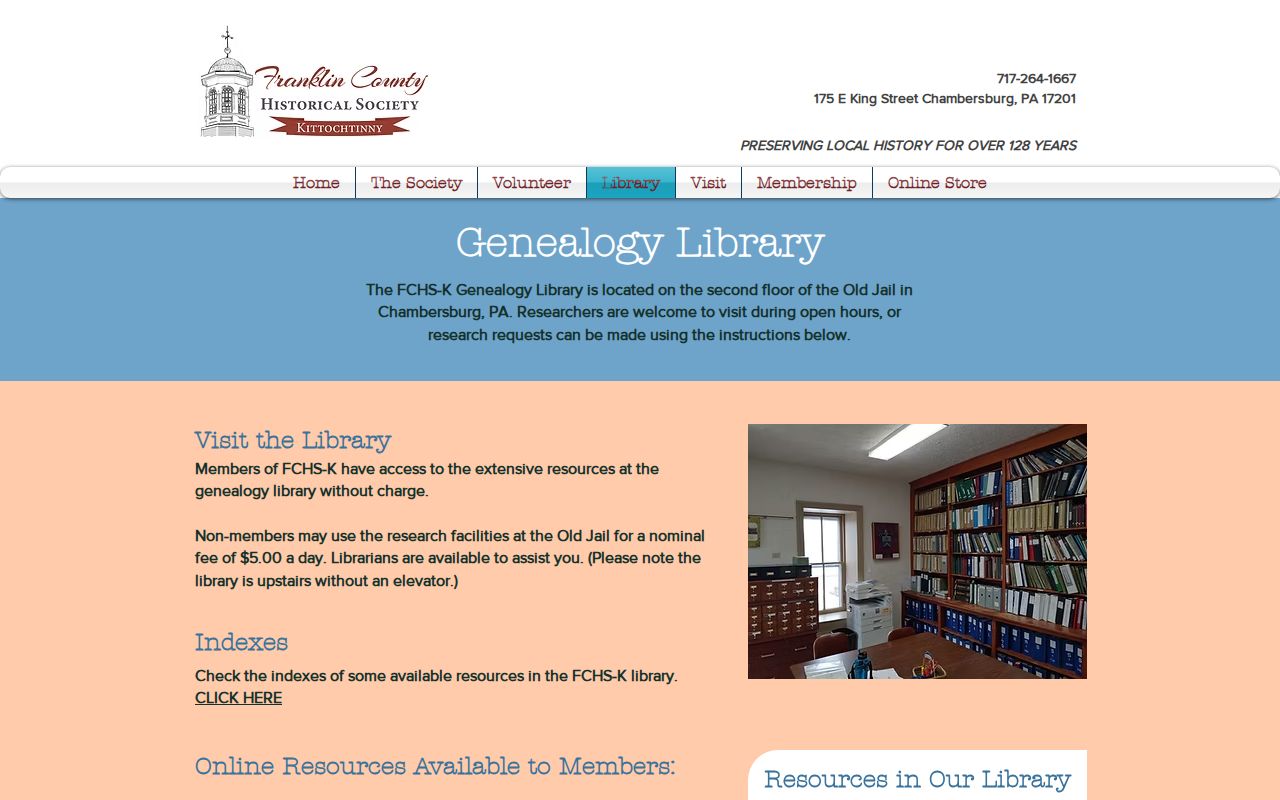
The historical society page is the direct starting point for asking staff about a specific Chambersburg directory edition or companion source.
Read a Chambersburg Directory Entry
A directory entry is an editorial listing, not an official certificate of residence. The verified collection-level fields for the city-and-business-directory material are person name, occupation, and address. A particular volume may also use abbreviations for residence, spouse, widow status, business activity, ownership, or boarding, but those marks must be read from that volume’s front matter. No open image of a Chambersburg entry was captured for this research, so a fictional sample would be misleading.
| Person name | A listed person name, often best searched with surname and initial variants. |
|---|---|
| Occupation | A verified collection-level field that can separate people with the same name. |
| Address | A verified collection-level field, useful as a dated lead rather than proof of occupancy. |
| Volume abbreviations | Read the key printed in the inspected volume before expanding any shorthand. |
| Additional marks | Spouse, widow, ownership, and boarding notation may appear in some directories, but are not verified for every Chambersburg edition. |
- Criss-cross directory
- A directory arranged by address rather than by surname. No verified local run was located, so inspect any requested volume before calling it one.
- Householder index
- An index that organizes entries by a household head or address when the volume supplies that structure.
- Abbreviation key
- The book’s own decoding guide, commonly found in front matter and necessary to read its terms accurately.
- Directory edition
- One dated publication, which should not be confused with an uninterrupted collection run.
Chambersburg Directory Gaps
Directories and telephone books can omit children, boarders, recent arrivals, people who declined a listing, and unlisted telephone customers. An entry can also preserve an older address after a move. There is no verified complete annual Chambersburg directory bibliography in the research, and no verified local reverse or criss-cross run. A missing result therefore calls for a catalog, counter, archive, or historical-society check, not a broad conclusion about the household.
The FCHS-K paid research service is a remote option when a visit is not possible. It charges $30 for one to two hours, includes five sources and up to ten copies, with additional copies at $0.25. The county Archives also encourages phone or email contact and appointments because its public catalog is not exhaustive. Those channels are more reliable than treating a search-engine snippet as proof that a directory page does or does not exist.
FCHS-K research services describes the paid option and its included research allowance.
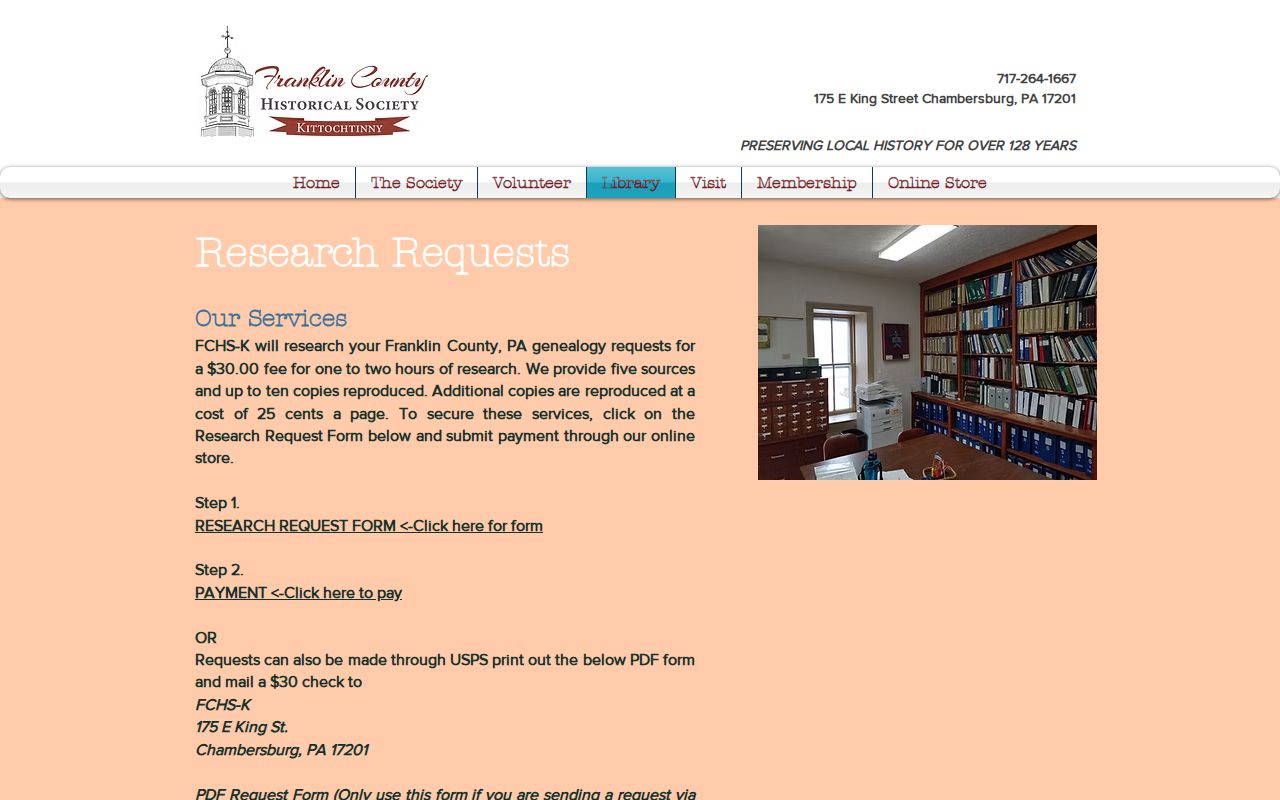
The research-service route is a documented fallback for checking a named edition when the directory shelf cannot be visited.
Trace a Chambersburg Directory Household
Build a household trail one edition at a time. Begin with a surname and initial, capture the address and occupation from a confirmed entry, and then compare adjacent available editions. A spouse or widow notation, changed work address, or move can be a useful clue, but it needs another identifier. Pair the directory date with the nearest released federal census, which currently reaches 1950 under the 72-year release rule. Compare the household composition rather than matching a name alone.
- Find the earliest verified city directory or telephone edition that names the person, then record the exact title, year, page, address, and occupation.
- Check the next available edition, not an assumed annual volume, for an address move, occupation change, spouse clue, or missing listing.
- Compare the nearest released census household for age band, birthplace, relationship, and address variables available in that census.
- Test the address against Franklin County deed indexes or tax assessments, keeping owner records separate from household evidence.
- When the trail ends, check a death register, obituary holding, estate index, or cemetery resource and require agreement on at least two identifiers.
For mature Pennsylvania vital records, the historical route is different from a current certificate request. Birth records become public after 105 years and death records after 50 years under the Vital Statistics Law. The State Archives holds the mature originals, while the Franklin County Archives retains local historic material and selected registers. A current certificate has eligibility rules and should not be treated as an open city-directory substitute.
Pennsylvania vital-record genealogy guidance explains the historical route for family research.
Chambersburg Directories and County History
Franklin County was formed from Cumberland County in 1784. A family or land line that vanishes before that boundary may need a Cumberland County search rather than a claim that the Chambersburg record was lost. The Franklin County Archives preserves a long timeline: land and deed indexes start in 1784, estate material in 1784, Orphans’ Court records in 1785, valuation records in 1786, tax assessment books in 1848, and local birth registers in 1894. State vital records begin in 1906.
The Archives describes nearly seven miles of records and adds catalog records and digitized images daily. Its repository includes selected birth, death, marriage, estate, land, tax, naturalization, divorce, election, and related record groups. That scale makes it a useful partner for city-directory research, particularly when a name, occupation, or address needs a date-specific county source. The catalog is not complete, so a missing online result is a reason to ask staff.
State Archives archival birth and death copies provide a distinct historical-request route.
Chambersburg Directory Companions
Yearbooks, newspapers, obituaries, cemetery indexes, church and family Bible records, maps, atlases, and family-paper indexes can add the detail a directory lacks. FCHS-K lists Chambersburg and local yearbooks, a near-complete yearbook collection, Chambersburg graduates before 1915, newspaper access from the late 1700s to today through a member service, and several family-paper indexes. Wilson College archives and other local institutions named by the county are referral paths for historical material, not modern resident rolls.
Use these companions as corroboration. A yearbook may place a former student, an obituary may suggest a family relationship, and a newspaper may explain a move or business change. None should override a contradiction in a primary county record. Historic spellings also vary because clerks and publishers wrote names as they heard or understood them. Search surname stems, initials, spouse, occupation, and address rather than assuming a single modern spelling.
Note: Local newspapers and yearbooks add context, but a dated directory entry remains an editorial record that needs a second source.
The FCHS-K resource index identifies the society’s local research holdings and indexes.
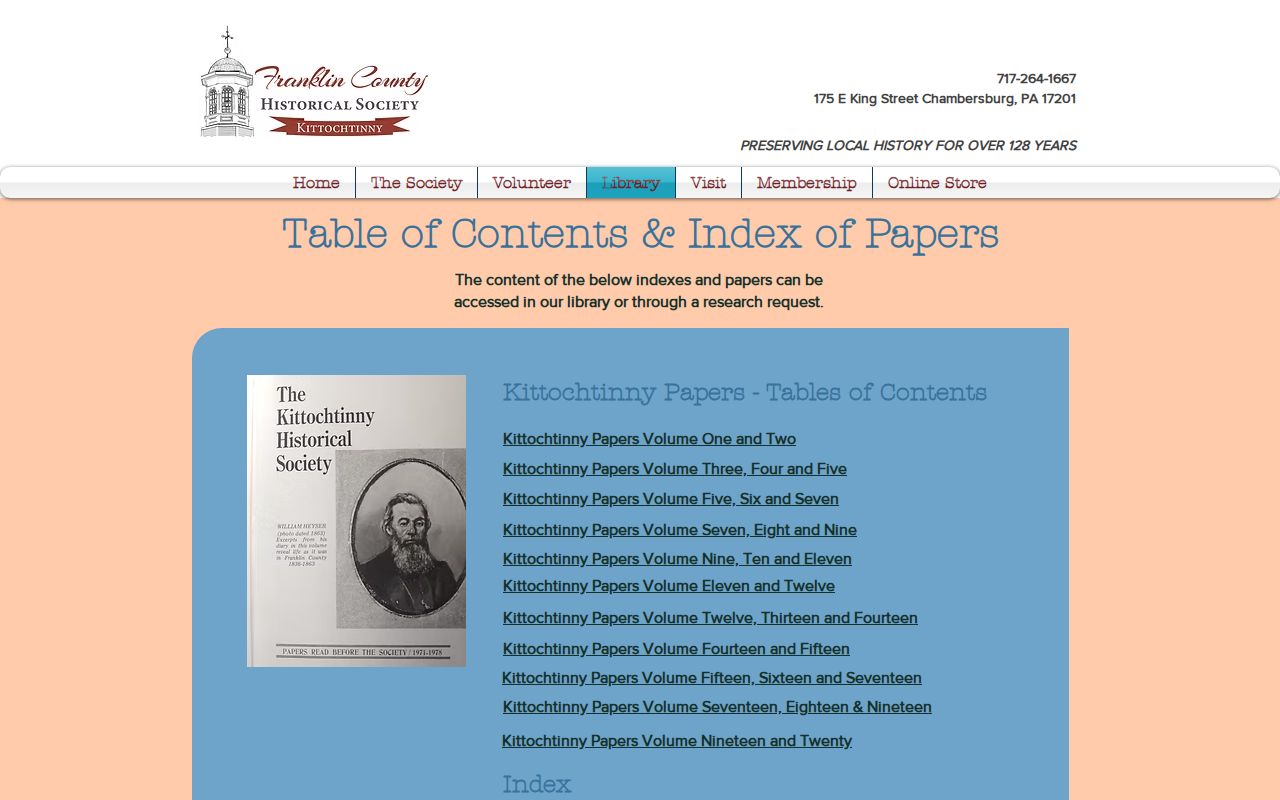
Its resource listing helps match an address or surname from a directory edition with a newspaper, cemetery, family-paper, or other corroborating source.
Chambersburg Directory Trail Endpoints
When a person disappears from the available Chambersburg directory editions, do not assign a reason from the absence alone. A move, death, changed household arrangement, unlisted telephone, or a gap in publication are all possible. Compare the next available directory with the nearest census, deed or tax record, estate material, obituary holdings, and the applicable vital-record route. That method keeps a directory lead from becoming a false certainty.
The state distinguishes current death certificates from public historical records. The Department of Health provides the current certificate process, while the State Archives supports archival requests for mature records. Franklin County Archives supplies local historic sources and the Clerk of Orphans’ Court handles county marriage records, subject to the documented restrictions. Match the custodian to the date and record type.
Pennsylvania death-certificate information shows the current state route and its eligibility limits.